Fig. 1. Big Fish poster.
Big
Fish (2003) directed by Tim Burton who also directed films
such as Edward Scissorhands, Frankenweenie and Sweeney Todd. Big Fish is a
story about a son trying to find out facts about his dying fathers life by
revisiting the tall tales his father had told him.
This review will attempt to break down the film’s structure;
it has an interesting structure because the film is broken up into two linear
stories that are told at the same time that end with the same outcome, yet have
very different versions of the journey. This could mean that the film has two
three act structures running side by side.
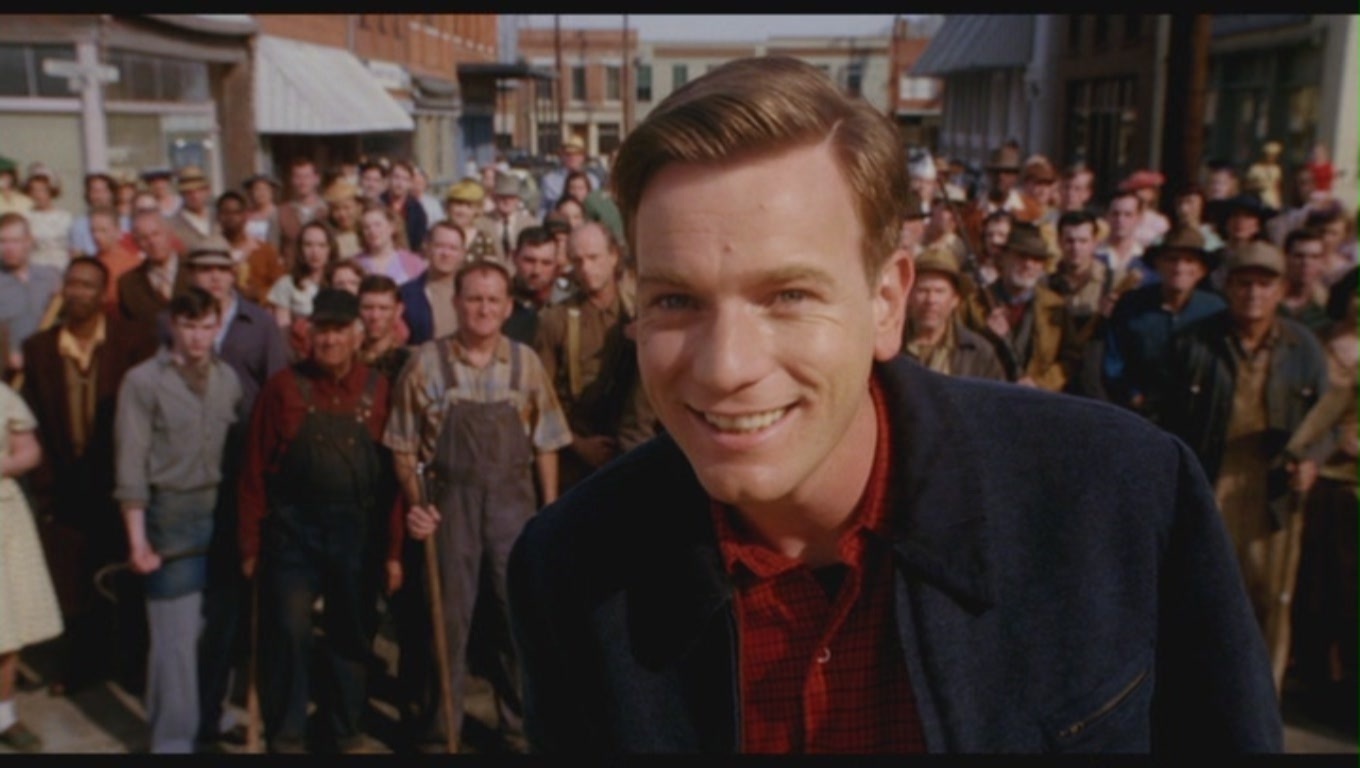
Fig. 2. Ed Bloom young.
The film itself has two worlds in it, the fantastical
world that our main character Ed Bloom describes in his tall tales and the real
world which is a lot more ordinary. In the fantasy world the exposition introduces
the main character in his youth; it shows him as a child that is fearless
enough to walk up to a witch’s house and ask to see her magical eye. This scene
gives the audience a strong understanding that Ed Bloom is a strong individual,
it also explains that he sees how he is going to die, however it doesn’t reveal
what actually happens. In the real world the exposition introduces the older Ed
Bloom, his wife Sandra, his son Will and his recent step daughter Josephine.
During this time we learn that Will doesn’t enjoy his father’s tall tales and
realises that he doesn’t actually know anything about him.
Next we have the inciting incident, in the fantasy world
this is Ed Bloom feeling like he is too big for the town he is in. He is a big
shot in a small town and feels like he needs more in life, one day a giant
appears in the town and Ed agrees to get rid of him. Ed ends up leaving with
the giant in search of a better life. In the real world it could be that the
father being sick with cancer is the inciting incident, this is because it sets
Will in motion to find out facts about his father’s past, away from the wild
reality that is told in Ed’s stories.
Plot point one in the fantasy world is Ed Bloom trying to
find his purpose in life, it is him trying to discover what he is meant to do
with all of his greatness. This leads him to accidentally arrive early in a
town called Spectre and then continues to push him through his journey. In the
real world however, Will is trying to find out what he can about what really
happened in his father’s life. This leads him to argue with his father and get
increasingly more irritated by his father’s stories.
Both stories have their own obstacles, in the fantasy
world these consist of Ed trying to find out information about the young lady
that he fell in love with. He works for a circus in which he receives no pay;
each month he works he is given a little snippet of information about the young
lady instead. He encounters a werewolf and after taming it he is given the
final information he needed to find his love. In the real world Ed’s condition
starts to get worse and he slowly becomes sicker. He also refuses to tell the
son any factual information about his past and claims that all of his stories
are true, making it hard for Will to understand his father.
The first culmination arrives in the fantasy world when
Ed is finally married to the girl of his dreams and he gets called away to war,
he faces many challenges while out at war and has a hard and long journey home
to see his wife. In the real world it could be that the first culmination is
Will trying to talk to his father, asking for facts about his past. This causes
an argument which halts Wills attempts to discover who his father really was.
The second plot point could potentially be Will
discovering his fathers ‘office’ in which he finds documents that lead Will to
believe his father cheated on his mother. This leads Will to travel to Spectre
in search of the lady (Jenny) who he believes his father had an affair with. Jenny
tells Will the fantasy side of the story in which, Ed helped rebuild Spectre by
using his wealthy connections. This could possibly be the second plot point in
the fantasy world, Ed trying to rebuild Spectre and being unable to get Jenny
to sell her house to him.
Fig. 3. Ending scene.
It appears that the climax is when Ed has a stroke and is
rushed to hospital, in the real world the son has found out that his father
didn’t cheat and arrives to the hospital late. He stays with his father until
he wakes up and is then asked to tell him how he is going to die, Will explains
the events and it transitions into the fantasy world in which Ed is seen off by
everyone from his stories. It could also be that Will sees that his father’s
stories weren’t complete acts of fiction and the people in them were real.
Finally the resolution of the film unites both stories as
Will now shares his father’s tales with his children, so his father lives on
through the stories that he told throughout his life. This leaves us with a
partial ending, as even though the father is dead the son has now started to
tell his stories.
To summarise Big Fish appears to have two stories that
follow the three act structure separately, both meeting at the end. These
stories cover most of if not all of the points in the three act structure;
however they tell them in a fragmented fashion which makes for an interesting
viewing experience. Overall it was an enjoyable film with lots of interesting
elements that can potentially bring out some strong emotions from its viewers.
Illustration List: